Lessons in Leadership, Organizational Resilience, and Operational Continuity During a Military Coup
By Jorge Daniel Mejía
When organizations develop their Business Continuity Plans (BCPs), they typically prepare for natural disasters, cyberattacks, pandemics, fires, or technology failures. Yet one scenario often receives far less attention than it deserves: political crises and social unrest.
In Latin America, these are not hypothetical scenarios. They have occurred across multiple countries and continue to pose significant risks to institutional stability, freedom of movement, supply chains, the safety of people, and the continuity of operations.
Over more than twenty years leading security for a higher education institution, I have managed a wide range of complex situations, including pandemics, national emergencies, institutional crises, and the 2009 Military Coup in Honduras. Each event offered valuable lessons, but few tested an organization’s ability to adapt as profoundly as the 2009 military coup in Honduras.
When Normality Disappears
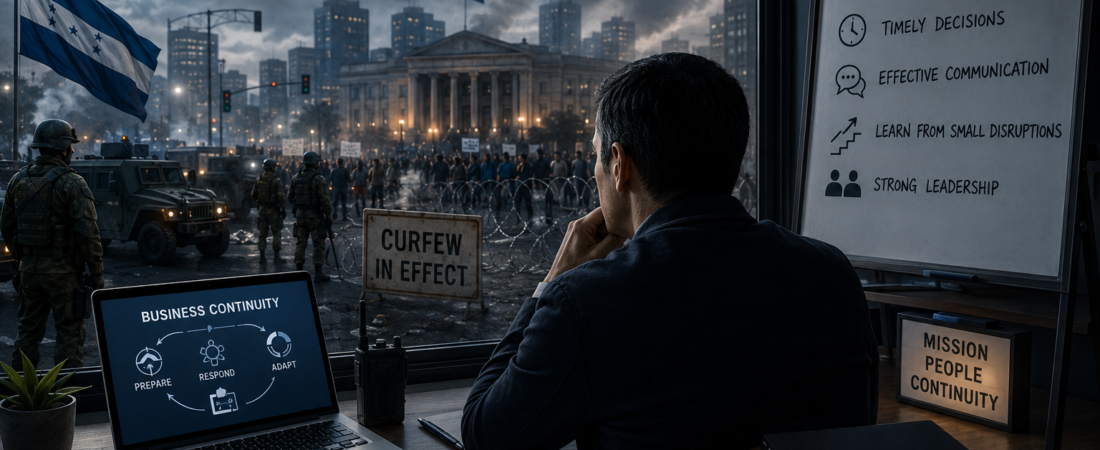
Among the first consequences of the 2009 Military Coup was the implementation of nationwide curfews and severe restrictions on movement. Within hours, daily life changed dramatically. Streets were controlled by the military, public transportation came to a halt, and uncertainty became the greatest challenge facing organizations (Truth and Reconciliation Commission, 2011).
For a higher education institution, the impact was immediate. Thousands of students, faculty members, and staff were unable to reach campus. In-person academic activities were repeatedly suspended, and daily operations became dependent on factors entirely outside the institution’s control.
It quickly became clear, however, that mobility was not the greatest challenge.
The real challenge was not the lack of mobility—it was the lack of reliable information.
Information Can Be as Critical as Physical Security
During a political crisis, information changes by the minute. Social media, traditional news outlets, messaging applications, and rumors rapidly circulate conflicting reports about roadblocks, demonstrations, violent incidents, and new government restrictions.
Making decisions based on unverified information can be just as dangerous as making no decision at all.
It was during this period that we realized one of the most valuable assets for maintaining operational continuity was not technology itself, but the ability to develop strong situational awareness.
While many organizations relied exclusively on third-party reports, our security personnel became a trusted source of first-hand intelligence. Because private security companies were authorized to travel using official credentials and government-issued safe-conduct permits, our teams were able to verify conditions throughout the city, confirm road closures, identify safe travel routes, and validate critical information before it reached decision-makers.
In many cases, the difference between reacting and anticipating events was measured in minutes.
Small Crises Prepare Organizations for Bigger Ones
Another important lesson was realizing that organizational resilience is not built during a major crisis—it begins long before one occurs.
For years, we had experienced roadblocks, public demonstrations, temporary disruptions, and other events that partially affected our operations. Each incident forced us to develop alternative ways of maintaining essential functions.
One of the most valuable initiatives was the gradual expansion of our virtual capabilities.
What initially emerged as a solution for temporary operational disruptions eventually became—without us fully realizing it—one of the primary mechanisms for sustaining academic continuity during an event as disruptive as a military coup.
Looking back, those smaller disruptions had served as real-world resilience exercises, preparing the organization for a crisis of far greater magnitude.
Collaboration Is Also Part of Business Continuity
No organization can navigate a crisis of this magnitude alone.
One of the factors that most strengthened our response capability was the collaboration among security professionals, private-sector organizations, universities, and other stakeholders who shared verified, real-time information about the evolving situation.
When conditions change by the minute, trusted networks become as valuable a strategic asset as technology itself.
When the Crisis Ends… Another Challenge Begins
The lifting of curfews did not mark the end of the crisis.
Over the following months, a new challenge emerged: social polarization.
As is often the case after political crises, part of the population supported the events while another part strongly opposed them. Inevitably, that division began to surface within the university community.
In an institution with tens of thousands of students, faculty members, and employees, political discussions had the potential to escalate into internal conflict.
We made a deliberate decision to maintain strict political neutrality.
The message was clear and consistent: the university had to remain a space for respect, dialogue, and coexistence. Institutional political positions were deliberately avoided, and every effort was made to keep the focus on the university’s educational mission.
Over time, we confirmed that this approach played a significant role in preserving internal stability during a prolonged period of social tension.
The Real Learning Begins After the Crisis
Once normal operations were restored, we conducted a comprehensive review of everything that had taken place.
We analyzed which decisions proved effective, which required improvement, which processes succeeded because of prior preparation, and which depended more on favorable circumstances than sound planning.
This After Action Review (AAR) transformed experience into organizational knowledge and strengthened our preparedness for future disruptive events.
We came to understand that continuous improvement does not begin when a crisis ends—it begins when an organization is willing to learn from it.
Five Lessons Learned
That experience taught me that Business Continuity during a political crisis depends far less on written plans and far more on an organization’s capabilities.
Among the most important lessons were:
1. Obtain reliable, validated, and real-time information.
2. Transform information into timely and effective decisions.
3. Maintain clear and consistent communication throughout the crisis.
4. Learn from smaller disruptions to prepare for highly disruptive events.
5. Foster strong leadership capable of inspiring confidence and making sound decisions under pressure.
Conclusion
Political crises will continue to be part of the reality in many Latin American countries. While we cannot prevent them from occurring, we can prepare our organizations to respond more effectively.
Organizational resilience is not simply the ability to recover after a crisis.
It is the ability to continue operating when the environment changes abruptly, uncertainty becomes the dominant condition, and critical decisions must be made with incomplete information.
Ultimately, the most resilient organizations are not necessarily those with the most comprehensive plans or the greatest resources. They are the organizations that turn every crisis into an opportunity to learn, improve, and emerge stronger for the next challenge.
Every crisis eventually ends. The organizations that emerge stronger are those that transform experience into resilience.
References
ASIS International. (2019). Enterprise Security Risk Management: Principles and Guidelines. Alexandria, VA.
Coombs, W. T. (2015). Ongoing Crisis Communication: Planning, Managing, and Responding (4th ed.). Sage Publications.
Truth and Reconciliation Commission. (2011). Para que los hechos no se repitan: Informe de la Comisión de la Verdad y la Reconciliación. Tegucigalpa, Honduras.
International Organization for Standardization. (2017). ISO 22316: Security and Resilience — Organizational Resilience — Principles and Attributes. Geneva, Switzerland.
International Organization for Standardization. (2019). ISO 22301: Security and Resilience — Business Continuity Management Systems — Requirements. Geneva, Switzerland.
Organization of American States (OAS). (2009). Resolutions and Documents on the Political Situation in Honduras. Washington, D.C.